
You're usually looking into septic tank emptying at the same moment something has changed. Drains are slower than normal, there's a smell near the inspection cover, or you've just realised you don't know when the tank was last serviced. In the UK, the right answer isn't “empty it every year no matter what”. The right answer is to empty it before sludge carryover starts causing drainage field trouble or a compliance problem.
Table of Contents
- What Septic Tank Emptying Is and Signs You Need It
- How Often to Empty Your Septic Tank in the UK
- Typical Costs for Septic Tank Emptying and Price Factors
- What Happens During a Professional Emptying Service
- Why Choose Anytime Drain Solutions for Your Septic Tank
- Frequently Asked Questions about Septic Tanks
What Septic Tank Emptying Is and Signs You Need It
Septic tank emptying is the removal of settled sludge from the bottom of the tank and scum from the top, not just the liquid in the middle. The aim is simple. Keep solids inside the tank and stop them reaching the outlet pipe, drainage field, or soakaway where they can cause blockages, ponding, and long-term failure.
A lot of homeowners treat it like a one-off clean. It isn't. It's routine preventative maintenance, in the same category as checking a roof before a leak becomes ceiling damage.
What emptying actually removes
Inside a working septic tank, wastewater separates into layers. Heavier solids settle, lighter material floats, and partially clarified effluent leaves through the outlet. If the sludge and scum layers build too far, the tank stops separating properly and starts pushing solids onward.
That's when trouble begins. Once a drainage field takes solids instead of settled effluent, recovery can be difficult and disruptive.
Practical rule: If you wait for sewage backup, smells indoors, or a boggy patch over the soakaway, you've probably left it later than you should.
If you're unsure what type of off-mains system you have, it helps to understand the difference between a septic tank and a cesspit and how it stores waste. The maintenance pattern is very different.
Symptoms that need attention
Some warning signs are obvious. Others are easy to dismiss until the system is already under strain.
| Symptom | What It Means | Recommended Action |
|---|---|---|
| Slow drains across more than one fitting | The issue may be beyond one appliance and affecting the system as a whole | Arrange an inspection and check service history |
| Gurgling from toilets or waste pipes | Air movement can point to restricted flow or a struggling outlet | Don't keep using large volumes of water until it's assessed |
| Sewage smell near the tank, manhole, or garden | The tank may be overdue, overloaded, or not venting correctly | Book professional emptying and inspection |
| Wet or boggy ground near the drainage field | Effluent may not be dispersing properly | Reduce water use and get the system checked promptly |
| Grass over the soakaway looks unusually lush | Nutrient-rich effluent may be escaping too close to the surface | Treat it as a warning, not a gardening benefit |
| Backup into low-level toilets or showers | The system may be at capacity or the outlet may be obstructed | Stop discharging more water and call for urgent help |
A single slow sink doesn't always mean the tank is full. A house-wide pattern is more significant. The same goes for external signs. One damp patch after rain is one thing. A persistently soft or odorous area around the drainage field is another.
How Often to Empty Your Septic Tank in the UK
For homes in England and Wales, the legal baseline isn't a fixed pumping date. It's the duty to keep the system from causing pollution. Since 1 January 2020, septic tanks can't discharge directly to surface water, and common UK guidance still points to emptying roughly every 1 to 3 years, with the actual interval depending on tank size and household occupancy, as outlined in this summary of UK septic tank pumping frequency and compliance.
Why there isn't one fixed UK schedule
This catches a lot of people out. They ask for the “correct” interval, expecting one answer that suits every property from a holiday cottage to a full family home. That isn't how septic systems behave.
A small household often goes longer between services because less sludge builds up. A larger household fills the usable sludge storage faster. If occupancy changes, the tank doesn't care what your old diary reminder says.
The practical trigger is solids accumulation, not a calendar alone. Technical guidance used in the sanitation sector indicates desludging is appropriate when solids occupy about one-half to two-thirds of the tank depth, and design guidance uses around 25 litres of sludge and scum per person per year for toilet-waste systems in calculations, as set out in this septic tank guideline.
A septic tank is a process, not a bin. The important question isn't “Has a year passed?” It's “How much sludge is actually in there now?”
What changes the interval in real homes
In Dorset, Bournemouth and the South of England, I'd always want to know three things before suggesting a maintenance rhythm.
- How many people use the property. A tank serving one person behaves very differently from one serving a family or a let with changing occupancy.
- How much water goes through the house. Long showers, frequent laundry, and high guest turnover can upset retention time even if the tank size is decent.
- Whether the downstream drainage field is healthy. A struggling soakaway makes the whole system less forgiving.
Tank geometry matters too. A tank that's awkward to access, shallow, or poorly maintained may not empty as effectively in practice as one with proper manhole access and decent liquid depth.
The best habit is simple. Keep a written record of pumping dates, any inspection findings, and changes in occupancy. If a property moves from occasional use to full-time use, reassess the interval straight away instead of waiting for symptoms.
Typical Costs for Septic Tank Emptying and Price Factors
Price is one of the first questions people ask, and it's fair enough. The problem is that septic tank emptying isn't priced properly from tank size alone. Access, hose run, property layout, and whether the contractor is dealing with a routine visit or an urgent overflow all affect the job.
In practice, the cheapest quote isn't always the best value if it only removes easy liquid and leaves heavy sludge behind. Proper desludging takes the right tanker, enough time on site, and access through the correct opening.
What affects the price
A contractor will usually look at the following before confirming cost.
- Tank size and waste volume. Larger tanks take longer and may require more waste handling.
- Vehicle access. If the tanker can't get close, longer hose runs add time and complexity.
- Site conditions. Buried covers, awkward gardens, steep access, and poor lid condition can all slow the work.
- Urgency. An emergency attendance for backup or overflow is different from a pre-booked maintenance visit.
- What's found on site. If the tank is overfull, collapsed, or the outlet is obstructed, emptying may only be part of the job.
Septic tank versus cesspit
Homeowners sometimes compare prices without comparing systems. A septic tank separates solids and discharges effluent onward. A cesspit is a sealed holding tank, so every litre stays in storage until removed.
That's why a cesspit often needs more frequent attendance and why service planning matters. If you're budgeting for an off-mains property, it helps to understand how sewage storage tanks differ from treatment systems before you compare quotes.
Cheap pump-outs can be false economy if the contractor can't reach the main manhole, won't inspect the outlet condition, or leaves you with no clear record of what was removed.
What Happens During a Professional Emptying Service
A proper visit is controlled, methodical, and more technical than many homeowners expect. The engineer isn't just “sucking out the tank”. They're checking access, removing waste safely, watching for signs of structural or outlet trouble, and making sure the contents are handled lawfully.
Early in the visit, the process looks like this:
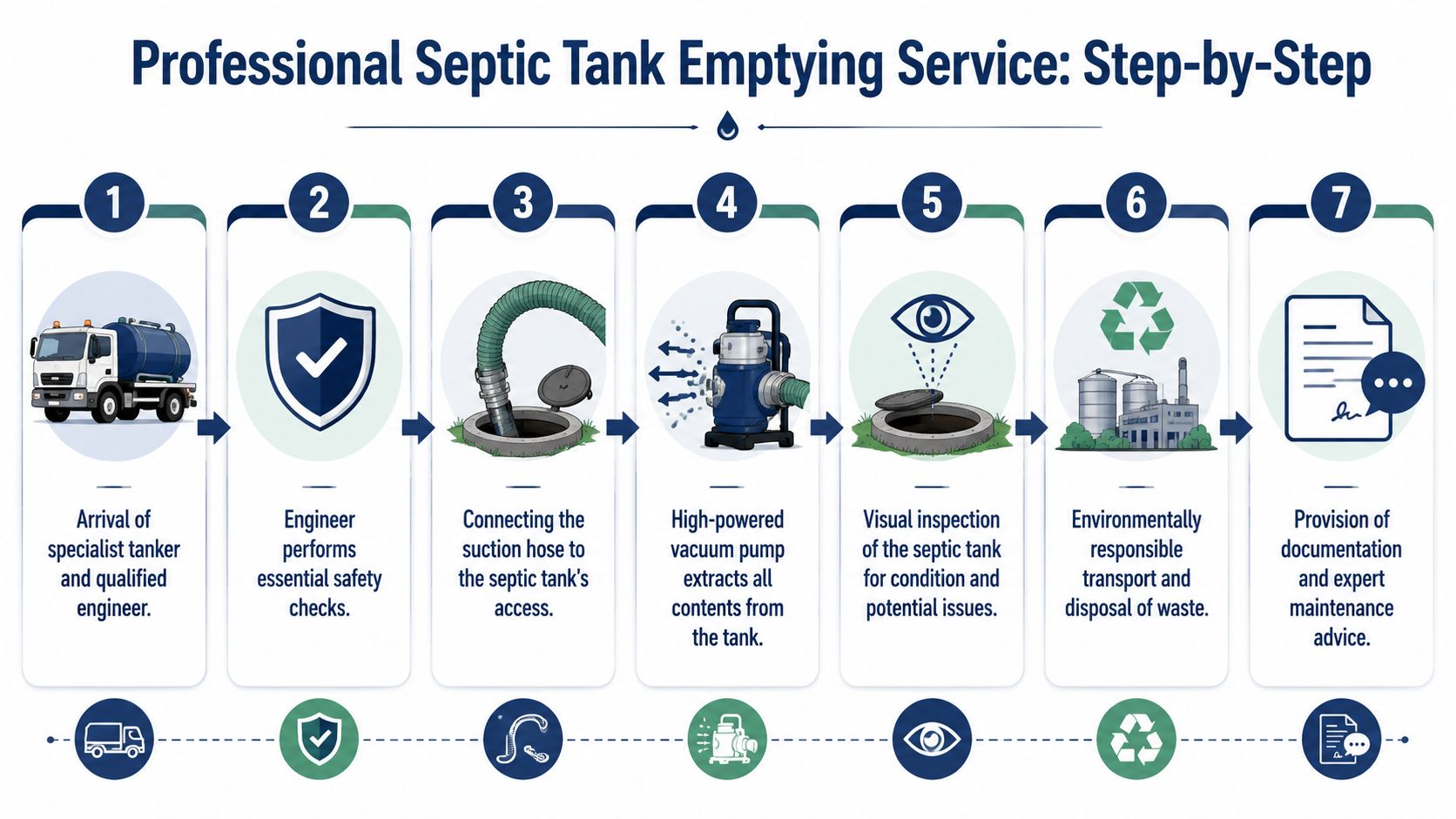
The job from arrival to pump-out
The tanker arrives and the engineer confirms the tank location, access route, and the correct covers to open. That matters because proper emptying should be carried out through the main manhole, not improvised through a small opening that only gives partial access.
The next step is the pump-out itself. Dense sludge sits on the bottom and won't come away properly unless the vacuum hose is positioned for full extraction. Guidance used in the sector states that professional emptying needs vacuum extraction via the main manhole, with a minimum liquid depth of 1.2m and adequate access for safe solids removal, which is why partial pumping through smaller access points is unreliable, as explained in this technical note on septic tank emptying.
A short explainer is useful if you want to see the principle in action.
What a proper contractor checks afterwards
Once the contents are removed, the engineer can often make a more meaningful visual check of the internal condition. At this stage, defects such as damaged inlets, poor benching, outlet issues, or signs of past overflow become easier to spot.
If there's any doubt about the line leaving the tank, an empty or recently serviced system is also a good time to book a septic tank inspection and condition check. Where outlet defects or downstream restrictions are suspected, a contractor may then recommend a more detailed look, such as a CCTV inspection of the connected drainage.
One useful point for homeowners is this. Good contractors don't treat septic work in isolation. If the problem turns out to be a collapsed outlet, root ingress, displaced joint, or failed drainage run, the answer may sit within wider drainage services such as diagnosing the line with a CCTV drainage survey, not repeated pump-outs.
Why Choose Anytime Drain Solutions for Your Septic Tank
Off-mains drainage problems rarely stay neatly inside one category. A full tank may only be part of the picture. The underlying fault could be a blocked outlet, a compromised lateral drain, a root mass in older pipework, or a drainage field that's no longer taking flow as it should.
That matters in Dorset, Bournemouth and the South of England because property types vary a lot. Rural homes can have older drainage layouts with awkward access, while mature gardens and established boundaries increase the chance of root ingress into connected pipework.
When local drainage knowledge matters
Anytime Drain Solutions handles emergency and planned drainage work across the region, with 24/7 emergency callouts, no call-out charge, and a 1-hour response time across Dorset and Bournemouth for urgent issues. The practical advantage is that a fully qualified engineer can empty the tank, assess whether the problem sits in the tank itself or further along the system, and then move into the right next step if needed.
If a septic issue exposes another defect, that can lead into Drain Repairs, Root Removal, Soakaway Installations, or no-dig remedial work such as Drain Lining & Patching where suitable. On lining repairs, cover can be offered with up to 10-year guarantee depending on the repair.
The useful question isn't “Who can pump this out?” It's “Who can tell me whether pumping will actually solve the problem?”
That broader view is often what saves homeowners from paying for repeat attendances when the actual cause is further downstream.
Frequently Asked Questions about Septic Tanks
A few questions come up repeatedly on septic jobs in Dorset and across the South of England. The right answer usually depends on how the system is set up, how the property is used, and whether the discharge still meets current rules.
Is a septic tank the same as a cesspit
No. They are different systems with different maintenance needs.
A septic tank separates solids from liquid effluent, then sends the liquid on to a drainage field or another compliant discharge point. A cesspit stores all waste and has no outlet, so every litre stays in the chamber until a tanker removes it.
For homeowners, that affects cost, servicing frequency, and the risk of overflow if collections are missed.
Can additives replace emptying
Additives do not replace desludging.
If sludge and scum have built up to the point that settlement is no longer working, the waste has to be removed. Pour-in treatments may change odour or marketing claims may suggest less maintenance, but they do not take solids out of the tank.
Some products are sold as a shortcut. They aren't a substitute for getting a tanker on site and removing the waste.
What should never go into the system
A septic tank works best when it only receives toilet waste, household wastewater, and ordinary toilet paper.
Keep out wipes, sanitary products, nappies, fats, oils, grease, food waste, coffee grounds, paint, solvents, bleach-heavy cleaners, and other harsh chemicals. “Flushable” on the packet does not mean suitable for septic systems. In the field, wipes are still one of the commonest causes of blockages and preventable callouts.
Clean water can cause trouble too. Roof water, yard drains, and groundwater should not enter the foul system. Too much extra flow reduces settlement time and can push suspended solids towards the outlet and drainage field.
Does emptying fix every septic smell
No. Emptying helps where the smell is coming from high waste levels, disturbed contents, or an overdue service.
Smells can also come from a failed cover seal, poor venting, a partial blockage on the outlet, a saturated drainage field, or damage on the run between the house and the tank. If odours return soon after pumping, it points to a fault that needs diagnosing rather than another routine empty.
That matters on older rural properties in Dorset, where original layouts are not always straightforward and foul and surface drainage have sometimes been altered over time without clear records.
If you need septic tank help in Dorset, Bournemouth or the South of England, Anytime Drain Solutions can assess whether the issue is routine emptying or a wider drainage fault. Call 01202 028 934 for 24/7 emergency callouts across Dorset and Bournemouth.

